On this page
- What is a bagan and how does it work?
- Where did the design come from?
- Why does a whale shark bagan attract sharks?
- Do bagans move around the bay?
- What is expected of visiting boats at a bagan?
- Why do people at a bagan throw or spray water?
- What are the concerns about more bagans?
- What else do people ask about bagans?
- Which sources support this page?
- How do I reach the desk?
By Saleh Bay Whale Shark Editorial Desk
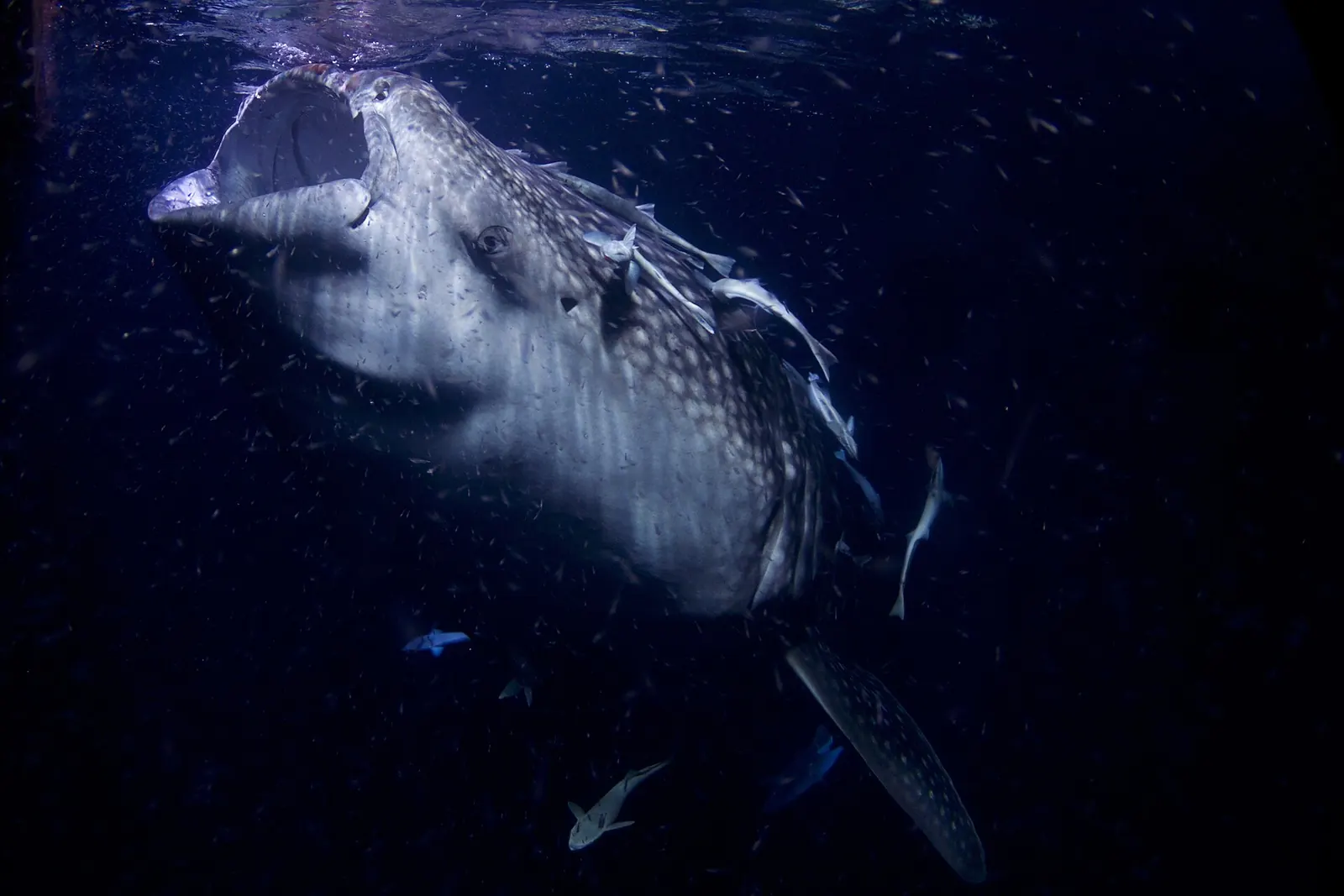
A whale shark bagan is a lift-net fishing platform where bright lights draw small fish, shrimp and squid at night, and whale sharks come in the early morning to suck baitfish from outside the net. In Saleh Bay these working rigs exist to catch fish. Visitor boats arrive because the sharks do.
What is a bagan and how does it work?
A bagan is a fishing machine with three working parts: a frame, a net and lamps. A paper in Diversity describes a wooden framework with bright lights that attract small fish, crustaceans and squid at night, and a large lift-net that catches small pelagic species including anchovies, scads and mackerels. Wikipedia gives the general type a net of about 9 by 9 metres, with mesh of 0.5 to 1 centimetre, on a rectangular frame of bamboo or wood. Those dimensions describe bagans broadly and were not measured in Saleh Bay, or Teluk Saleh as Indonesian sources call it.
The working cycle explains why a shark trip runs on such an odd timetable.
| When | What happens | Source |
|---|---|---|
| Night | Lights draw small fish, crustaceans and squid over the net | Diversity paper |
| During the fishing | The lift-net brings up catch. In Saleh Bay the targets are small pelagic fishes and sergestid shrimps | Diversity paper; IUCN shark specialist group factsheet |
| About 05:00 to 09:00 | Whale sharks are around the platforms, then no longer seen there | 2021 study |
| Around 07:00 | Fishers reported that two to four sharks nearly always visited and stayed about an hour | Fisher report in a study from around 2018, not a count |
| The evening before a trip | A local guide confirms active bagan with owners | The Langkah Travel, operator |
The fishers' seven o'clock pattern is their own report from years ago and should not be taken as a timetable. Nothing in it tells you what a given morning will bring.
Where did the design come from?
The Diversity paper says bagans originated in Sulawesi and are now widely used across Indonesia. Wikipedia adds that Makassarese and Bugis people introduced them in the 1950s. Those statements fit together, but they describe the gear nationally. Neither one dates the first platform in Saleh Bay.
A whale shark bagan is not a separate type of rig. The name simply records what turns up at the net. Fishers in Labuan Jambu told a 2021 study they had seen whale sharks in the area since 1992, so on their account the sharks are no recent arrival at this bay.
Why does a whale shark bagan attract sharks?
Food gathers there in concentrated form. The IUCN factsheet says whale sharks are regularly seen sucking baitfish from the outside of the net. Antara says they crowd the platforms to eat small fish and rebon shrimp that fishers do not take home. The 2021 study names small shrimp called masin in the local language, and krill, among bagan catches used as whale shark food. For the wider diet, see what whale sharks eat in Saleh Bay. Our Saleh Bay whale shark overview places the platforms in the wider story.
Whether the attraction is natural gets argued often, and the evidence splits two ways. The IUCN factsheet says local ecological knowledge indicates the sharks fed on krill and small pelagic fish in the area long before the bagan fishery, since 1992, which supports a natural origin for the feeding. That history tells you nothing about baiting today. Whether a given crew uses bait now is a separate question, and the page on Saleh Bay whale shark ethics takes it up.
The fishers have their own reading. Those quoted by Mongabay treat the sharks as a good omen, because they signal small fish nearby.
Do bagans move around the bay?
Yes, a Saleh Bay bagan can change position during the year. Interviews with fishers in the 2021 study indicated that platforms shift from the east of the bay to the west as the wet western season brings rain and strong winds, seeking shelter around islands. Antara reported a sharp example in early 2025, when dozens of bagan sheltered at Rak Island; our weather page has the details.
For a visitor, this means no fixed spot exists to mark on a map. The calls a guide makes the night before, shown in the table above, matter because the working platforms change. It also follows that the boat ride can differ from one morning to the next, depending on where the fleet is working.
How many are out there? The Langkah Travel says hundreds of bagan operate across the bay every night. That is an operator's description, and no official count has been published that this page can cite, so treat "hundreds" as a rough impression only.
What is expected of visiting boats at a bagan?
A ministry guideline document on whale shark tourism asks snorkellers to stay around a rope or floating bar provided by the operator, and boats to moor on the bagan. The copy in circulation has a blank number and is filed as meeting material, so read it as guidance on paper and do not assume it is enacted law. Check what your boat crew will actually do before you go out.
Each bagan fishing platform is also someone's workplace. Owners and crew may have been up all night, and nets and lines are their livelihood. Ask your crew how access to the platform works. Local rules are collected on the Saleh Bay whale shark rules page, and practices differ between boats, so raise any concern with your provider before you pay.
Why do people at a bagan throw or spray water?
Two visitor accounts describe water put on the surface. Dive Happy says local fishermen throw cups of water into the sea because the splashing attracts whale sharks. Peter Orsel describes a man spraying water onto the surface, and says the air bubbles draw the sharks up from below. We know of no study that tests either explanation, so treat both as what observers saw. Neither account says who asked for it or how often it happens, so you can ask a seller whether this is done at its bagans, and whether it happens while guests are in the water.
What are the concerns about more bagans?
The largest worry is about food. A researcher quoted by Mongabay says that if bagans keep expanding, there may eventually not be enough food for whale sharks. That is a warning about a possible future. It comes with no measured threshold for the bay.
Young sharks can also end up in the gear. The Diversity paper records that on 6 September 2024 a male neonate of about 135 to 145 centimetres was caught by accident in a bagan lift-net, held for about six minutes in a seawater cooler box, then released. A single record says nothing about how often this happens, though it does show that the nets and the smallest sharks can meet.
What else do people ask about bagans?
What is a bagan?
A bagan is an Indonesian lift-net fishing platform. A frame, usually wood or bamboo, holds a large net and bright lights. The lights attract small fish, crustaceans and squid at night, and the net catches small pelagic species such as anchovies, scads and mackerels.
Why do whale sharks come to bagans?
They come for food. An IUCN factsheet says they suck baitfish from the outside of the net, and Antara says they eat small fish and rebon shrimp that fishers do not take home. A 2021 study reports them there from about 05:00 to 09:00.
Where did bagans come from?
A paper in the journal Diversity says bagans originated in Sulawesi. Wikipedia says Makassarese and Bugis people introduced them in the 1950s. Both statements describe the gear in Indonesia generally, and neither dates the first platform in Saleh Bay.
Do bagans stay in one place?
No. Fishers told a 2021 study that platforms move from the east of the bay to the west in the wet western season, seeking shelter around islands. In a February 2025 storm, Antara reported dozens sheltering at Rak Island.
How many bagans are in Saleh Bay?
We know of no official count. The Langkah Travel, an operator, says hundreds of bagan operate across the bay every night. That figure is a company's description and not a census, so treat it as a rough impression.
Which sources support this page?
- Diversity (MDPI) paper on Saleh Bay neonates and bagans
- Wikipedia: Bagan (fishing)
- IUCN shark specialist group factsheet: Saleh Bay
- 2021 IOP study on Saleh Bay whale sharks
- IOP study with fisher reports on visits
- The Langkah Travel: Saleh Bay guide (operator)
- The Langkah Travel: Sumbawa whale shark tours (operator)
- Antara: whale sharks and people in Saleh Bay
- Mongabay: 10-year satellite study
- Ministry guideline document on whale shark tourism
- Peter Orsel: swimming with whale sharks in Sumbawa (travel blog)
- Dive Happy: Saleh Bay whale sharks
How do I reach the desk?
If you want to ask how a provider handles bagan access, bait or crew fees, put the question to the desk and it will tell you what it can find out. Since a request may end in a paid booking, we have a commercial interest in the outcome. The desk cannot promise a sighting or a platform, and any terms apply only once a written offer sets them out. WhatsApp +62 811-3941-4563 or email bd@juaraholding.com.
Send the desk your dates and starting point. The desk replies in writing.
Ask the desk on WhatsApp bd@juaraholding.com